Page after page
July 23, 2026, 6:23 am , by Richard Lutz
from Richard Lutz in Perthshire, Scotland
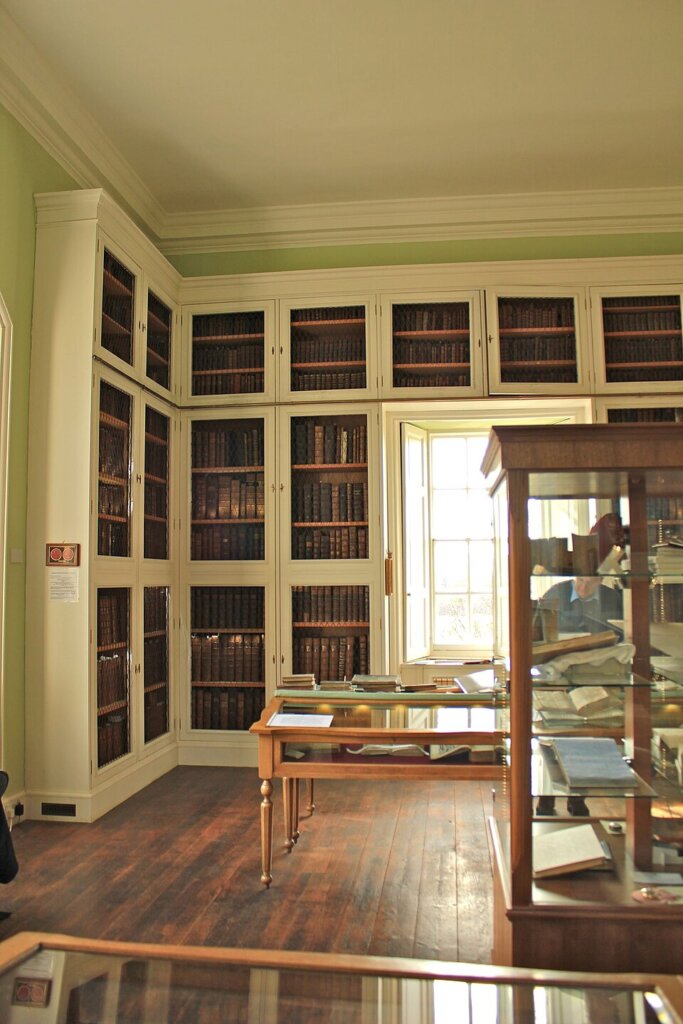
It’s a long twisting road to Innerpeffray Library; about as long and twisting as its 345 year history.
It began as the brainchild of a rich Scottish landowner back in 1680. David Drummond, the 3rd Lord Madertie, decided to open his vast personal library deep in Perthshire to everyone. His friends, his fellow gentry, his estate workers, the tradesmen and craftsmen of the county. It became, in effect, Scotland’s first public library and his enormous collection of books – stretching back to the 15thc- could be used and taken out until 1968.
Today the library, with its invaluable contents and full shelves, is a remote museum; two rooms of volumes that include religious tracts bound in vellum or oak, histories, a collection ranging from miniature pocketbooks to giant decorative volumes bound in gold and leather investigating topics from medicine to witchcraft to folktales to tips on how to correctly behave in public.
And just to remind visitors who touched base with this treasure trove, there’s the original borrowers’ record:
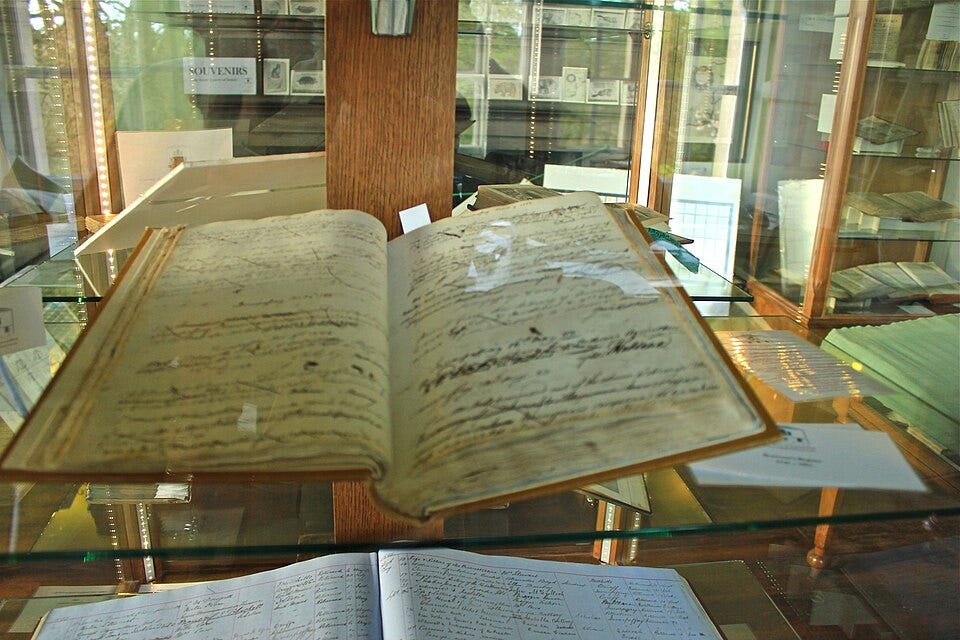
It logs in individual handwriting anyone who has taken out a book from 1747 until the lending service ended. And maybe even one or two who possibly failed to return a book that’s been overdue now for a couple of hundred years.
One borrower from the mid 1800’s was Thomas Stalker. In a grand gesture of Nominative determinism, he was (what else…) a gamekeeper. And quite a reader from the books he signed out: loads of Walter Scott, Robert Burns poetry, biographies of Nelson, Wellington, Cromwell and Napoleon.
And to show his interest in his job, Mr Stalker even borrowed a copy of ‘Forty years of a hunter’s life in the far interior of South Africa.’ Let’s hope the title didn’t reflect any verbosity in content.
One unique volume that took my eye is an original 16thc edition of Holinshed’s Chronicles. He was hired to record the world’s history from The Flood to the reign of Queen Elizabeth. Not an easy task….
His book was carefully removed from a shelf by the museum’s chief archivist. Shakespeare and contemporary writers such as Marlowe depended on Holinshed’s histories (no matter how inaccurate) for their own work. The ancient book was carefully opened. It was written around the time Shakespeare was growing up as a child- maybe about the 1570’s. This specific volume, in this quiet corner of a museum set in the rolling Perthshire farmlands by the curve of The River Earn bordered by the vague traces of a Roman road, concerns Irish and Scots history. The archivist, elegantly known as the keeper of the books, opens the volume to Holinshed’s record of Macbeth.
I read first about King Duncan. I read about Macbeth’s rise. I then read about the three witches. I read a single allusion about the ambitious Lady Macbeth.
Shakespeare gobbled this stuff up, created a dark unforgettable tragedy and expanded Lady Macbeth’s gripping role in his play from Holinshed’s single sentence. There are also simple woodcuts to illustrate the Holinshed history:
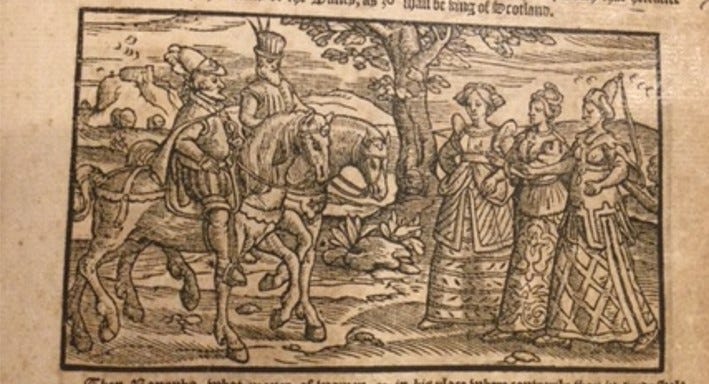
Here, Macbeth and Banquo, both well kitted out in contemporary riding gear, meet the witches who are also elegantly attired in formal Elizabethan dress. Nothing dreary and gloomy about this lot.
The archivist leaves the book open for me to continue reading, just as Shakespeare must have ploughed through it for his histories, even using Holinshed’s unintended mistakes to flesh out a good play, a good story, a successful drama.
There are 5000 other books to accompany Holinshed in the twin rooms. Drummond, the 17thc father of this lending library, had seen Civil War mayhem and war in his day. His book collection would mean, he was quoted as saying, that‘…quill would replace the sword…’
Photo credits: Innerpeffray Library
share this post!