
Home
December 12, 2025, 11:27 am , by Richard Lutz

By Richard Lutz
Wee Tommy and The Squeaker
I’m with Tommy. Or, as he’s known to many, Wee Tommy. He’s well over six foot.
He holds in his large hands a squeaker. He tells me you have to handle squeakers gently but firmly. We’re high on a breezy Ayrshire moorland.
A squeaker? It’s a baby racing pigeon and, somehow, this little thing has been put in a wicker basket with adults.
‘Must have been me,’ Wee Tommy says as he strokes the tiny bird and frees the others.
Twice a week Tommy drives from his coastal Scottish village and takes his pigeons out of his car and then opens the basket. They need exercise. They hesitate, have a coo or two, slowly circle overhead and then aim straight as an arrow southwest towards Tommy’s cottage. He holds back that baby racer and I ask how fast the flock flies. Normal speed is 36mph. A tailwind increases velocity to 45mph.
But how do they know where to go? I ask this as the racers are reduced to tiny specks, tattoos on a blue sky. ‘Instinct’ he says. And that’s the end of that. There goes DNA, hereditary traits, training. It’s instinct.
When we arrive back the birds are all either in the loft or relaxing on an outdoor ledge, probably checking out flight times, catching up on competition results, moaning about the poor Wi-Fi signal in the coop. Wee Tommy gently cajoles the squeaker out from the basket. It flutters to the roof of the car and after a gentle shush or two glides towards the coop. It’ll go to its mother. It’ll return home.
We all either turn towards home or maybe even turn our backs on home at some point. But home is there, someplace to contend with, lean on, retreat into, retreat from. But it’s there.
This all becomes a bit more relevant when, in the same week as I met the squeaker, I am told our old home of 38 years is on the market. We sold it four years ago. Now, it’s on the block again. I do what any red blooded person does: I go on the net. And there she is with an overblown AI sales pitch and waves of wide angle photographs. There’s even a video.
It’s strange, unsettling, to see the place has changed that you nestled in, stretched out in, slept in, furnished, raised a family in for almost four decades. What happened to the kitchen? Why alter the living room? How could they leave the garden so forlorn? And as for painting the dining room white and wiping out that soft violet colour that swam in afternoon sun? Well…..
Of course, the normal reaction should be to turn your back on history. We sold it, bought another place and that’s our lot. But it’s the change to your old life, your old home, room by room, which reflected who and what you were and wanted to be. And the boys’ rooms which mirrored their growth. That change is all there, on your laptop, on a screen, on a property website.
Maybe it’s because your home is the heart and blood of your life. You are spread into the walls, under the floors, in the wire and wood, ingrained into the paint and wrapped in the dust and memory.
But now, today, the house is reduced to a box of bricks spread across a digital page. And to be fair, 42 years ago, we did the same when we moved in, changed things, moved things around, made mistakes. But still, but still…
10,000 miles
And that brings me to the demise of Jan. She died in June. She was 96.
Every year for decades, she packed her bags, boarded a plane in Brisbane and flew 10,000 miles to the childhood home in Ayrshire. There she settled into her old one bedroom cottage, not 100 metres from Tommy’s house with his pigeons.
Once settled in, she’d hold court as old friends, family and neighbours dropped in to chat, help with groceries, talk about the weather, discuss the world’s wonders and cruel beauties, how the garden hedge was growing, how the western sun bounced off the harbour.
In the end, although she raised a family in Australia and travelled widely, this rolling corner of green earth was part of her. ‘It’s where I belong.’ she’d say in a soft Scots accent she never lost. ‘That’s why I return.’ And return, she did.
The German language has a word for this yearning. It’s heimat. It means more than an urge, actually. It’s a cultural pull, a need to be rooted, a force that draws you back.
It’s a need to come home. Just as Jan had a need to return. Decade after decade. And since she now lies somewhere that is forever Jan among the hills and curving shore, she and the memory of her is suffused with a fullness of heimat. And that corner of Ayrshire is suffused with the fullness of her. Jan, you see, was a lucky woman. She knew where she belonged
Someone who didn’t belong, who didn’t feel at home, who wasn’t wrapped in heimat, was an unknown Roman soldier made famous by a very well known poet. I was thinking of this ancient trooper as I walked in the Lowther Hills in Dumfriesshire.
One eyed warrior looking up at the sky
I was following the course of an old Roman Road which connects two valleys, The Nith and The Clyde.
The route was hammered out some 1900 years ago and today still charges northeast out of a sleepy hamlet called Durisdeer.
Above, skylarks swooped and sang. All around are names, names, names: Stonycleuch Rig, Stanebutt Hill, and (my favourite) The Wee Well Crags.
Not to be outdone, there’s also Well Hill, Well Height and, of course, the course of the Roman route itself which is, in some forms, now called The Well Path. Possibly, they’re all linked to a forgotten sacred water source hidden or simply dried up.
Protecting the old route and standing stern and unmoved in the heart of this terrain is a Roman fort.
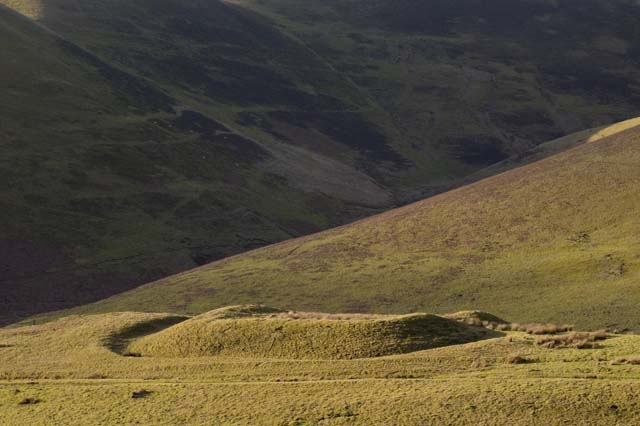
Photo: T. Robinson
Today it’s a rounded silent hump, a square encampment clasped inside a circular wall. At one time it was a forward garrison, built about 140AD, ready for action, guarding the long road through threatening hills.
On the earthen walls, I think of some grizzled sodden soldier on duty dreaming of a warm vineyard while wondering how he landed at this cold remote outpost of the empire, an empire that stretched itself too far.
That trooper could have been the grim nameless auxiliary WH Auden described when he knocked off a breezy ditty called Roman Wall Blues.
The weathered warrior is abroad, alone, adrift, away from a home where no one remembers him. He peers north into a bleak wilderness, on the look out for the enemy. Home is behind him, history, yesterday:
Over the heather the wet wind blows,
I’ve lice in my tunic and a cold in my nose
The rain comes pattering out of the sky,
I’m a Wall soldier, I don’t know why.
The mist creeps over the hard grey stone,
My girl’s in Tungria; I sleep alone.
Aulus goes hanging around her place,
I don’t like his manners, I don’t like his face.
Piso’s a Christian, he worships a fish;
There’d be no kissing if he had his wish.
She gave me a ring but I diced it away;
I want my girl and I want my pay.
When I’m a veteran with only one eye
I shall do nothing but look at the sky.
share this post!



Martin McCrindle
Never go back. Never go back.
Never acknowledge the ghost on the stair.
Keep to the track, to the beaten track,
No-one is waiting and nothing is there.
Gordon
Brilliant, Thanks!
MB
✌️
Sarah Bracken
On the business of an old house being resold, we had an identical experience, our former place got turned this year 4 years after we sold it and it similarly had been “modernised”
Andrew
Thanks for the descriptions and especially the poem.
It’s always the level of price inflation on past houses that shocks me.
Will Travel
Heimat is the right word indeed !!
H Mc
Pigeons are amazing
Rob
❤️
Jim G
Part of the human condition to ponder where we are going, especially in late 2025!
“An’ forward, tho’ I cannot see,
I guess an’ fear!”
At least the pigeons have it sussed.
Angela Cooper
Even a quote from Auden…. I felt much the same the first time our house was resold. It’s changed hands a couple more times since then. But as you say- we all move on….
Ian McDonnell
Here’s another poem you can probably relate to:
There is a sold sign on the lawn,
In front of the house where I was born.
Our family home where roots run deep,
With connections to cherish, to hold, to keep.
So many memories etched within,
Though the images are fading, growing dim.
A tie remains, a bond never to break,
The time we shared not wishing to forsake.
Not wanting to let go of the hand we once held,
In a lifetime that belonged to another world.
“Family Foundations” by Mary V. Botten
Robt B
Evocative
William Rice
I remember going back to the old home where I grew up and being amazed at how tiny it was! Eight of us lived in that 3 bdr, 1 bath home that was under 1000 sq. ft.
Ian Pryor
Pigeon fanciers…. they put the adult male into a coop with the hen for a day. He falls madly in love. Besotted, in pigeon ways. And he wants to fly back to her. That’s how it works.
Caroline Newson
On a visit back to Toronto I wandered around the old neighbourhood and past the house we’d bought and brought up the girls with great feeling of nostalgia and “heimat” … such a strange and strong connection to a place.
Ross Green
Blimey that takes me back. In the late 60’s our Auchenback scheme was awash with racing pigeon lofts. Most of them were rickety affairs but the birds obviously liked them as they kept coming back. I remember that the beans fed to the pigeons worked really when fired from our catapaults. I preferred budgies and had a collection of them in our shed at home. Entered some of them into the Barrhead and District Budgerigar and Foreign Bird Society competitions in the Westbourne Halls – they never won any prizes but i still loved
Bella Houston
Pigeons navigate using a sophisticated, multi-sensory “natural GPS” system, combining Earth’s magnetic field, the sun’s position, unique smells (olfactory cues), low-frequency sounds (infrasound), and familiar visual landmarks like rivers and buildings to create a mental map and compass, allowing them to find their way home from vast distances. They learn routes by flying them repeatedly, memorizing features, and rely on these cues for orientation.
Jamie Tunstall
‘how the western sun bounced off the harbour…’ 👍
Subscribe to new posts.